

Supersymmetry Research
Overview
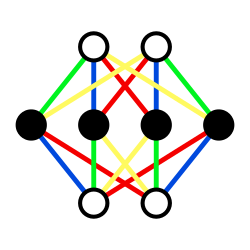
I worked with Dr. Sylvester Gates' research team on supersymmetry theory, focusing on classification and representation of off-shell supergravity theories. The research used "supersymmetry genomics" and adinkra diagrams to systematically analyze and classify supersymmetric representations.
Research Contributions
Core Research Areas
Supersymmetry Theory: Off-shell supersymmetry representations and their classification
Gauge Theory: Analysis of gauge symmetries and their relationship to field content
Group Representation Theory: SO(4) representations, Coxeter groups, and spinor algebra
Adinkra Symbols: Graphical representations for supersymmetric theories
Dimensional Reduction: Reducing 4D supersymmetric theories to lower dimensions
Technical Focus
Mathematical Frameworks
Classification of supergravity representations using "cis" and "trans" adinkras
Algebraic techniques for deriving closure relations
Analysis of supermultiplets and conserved supercurrents (Noether's theorem)
Kähler geometry in supersymmetric theories
Theoretical Physics
Off-shell vs. on-shell supersymmetry formulations
Supergravity configurations (minimal, non-minimal, conformal)
Dimensional enhancement and selection rules
Quantum field theory in supersymmetric contexts
Key Insights & Impact
Complete Classification: Pursuing systematic classification of supersymmetric representations comparable to Lie algebras—previously achieved only for limited cases
Selection Rules: Found constraints suggesting only four possible pairs of isomer numbers can characterize multiplets of a given size, potentially encoding information about higher-dimensional physics
Practical Applications: Model-independent approaches to:
Closure of the supersymmetry algebra
Solution of superspace constraints
Quantization procedures
Coupling to curved backgrounds via off-shell supergravity
Skills Developed
Mathematical
Group theory and representation theory
Spinor representations and gamma matrix algebra
Superspace formalism and supersymmetry transformations
Symbolic computation and algebraic manipulations
Physical Intuition
Recognizing deep structures underlying different theoretical frameworks
Understanding how selection rules emerge from consistency conditions
Pattern recognition in field redefinitions and their physical significance
Research Methodology
Systematic classification approaches
Mathematical frameworks for physics problems
Diagrammatic reasoning and visualization
Synthesis of mathematical and physical concepts
References
[1] Gates, S. J., Gonzales, J., MacGregor, B., Parker, J., Polo-Sherk, R., Rodgers, V. G. J., & Wassink, L. (2009). 4D, N = 1 Supersymmetry Genomics (I). JHEP 0912:008,2009. https://doi.org/10.1088/1126-6708/2009/12/008
[2] Buchbinder, I. L., Gates, S. J., & Koutrolikos, K. (2018). Interaction of supersymmetric nonlinear sigma models with external higher spin superfields via higher spin supercurrents. https://doi.org/10.1007/JHEP05(2018)204
[3] (1999). 4D, N = 2 Supersymmetric Off-shell Sigma-Models on the Cotangent Bundles of Kahler Manifolds. Fortsch.Phys.48:115-118,2000. https://doi.org/10.1002/(SICI)1521-3978(20001)48:1/3<115::AID-PROP115>3.0.CO;2-F